
Fluorex is a high-efficiency granular medium for removing fluoride from water, with a sustainable and regenerable solution for conventional systems.
Removing fluoride from water is a complex challenge due to its chemical properties: as a highly soluble and electronegative compound, it is difficult to remove through conventional methods.
Advanced solutions such as reverse osmosis are frequently used. However, these technologies are often too robust and expensive to treat low amounts of fluoride. For example, reducing the concentration from 2 ppm to 1 ppm to comply with fluoride regulations in Mexico requires removing all minerals from the water and disposing of up to 40% of the treated water, resulting in an expensive and inaccessible process for remote or vulnerable communities.
Dealing with this problem of inefficiency, we offer Fluorex as a solution to remove fluoride efficiently and safely.
Fluorex: the new high-efficiency defluorination medium.
Fluorex is a granular adsorbent material, based on hydroxyapatites, highly selective towards fluorides in water, where it exchanges the hydroxide ions anchored in its structure. It has a high fluoride adsorption capacity, even at low concentrations (0.5 to 4 mg per liter), which are the values that have been found in Mexico.
Fluorex’s structure is made of phosphates and calcium anchored to hydroxyl ions, allowing a process of ion exchange and chemical adsorption.
When water flows through the filter bed, fluoride ions replace the OH⁻ ions, being retained in the medium. Thanks to this high selectivity, the material achieves removals of 70% in just 12 minutes, reaching final concentrations below regulatory limits and making it ideal for deep bed adsorption systems, allowing for more compact equipment designs.
Likewise, this solution is presented in granular format, with particle sizes between 0.5 and 1.8 mm, which facilitates its installation in conventional filtration systems. Its operation is similar to that of a deep bed, with filtration speeds of 6 m³/m²·h and standard backwashes of 50 to 55 m³/h.
Fluorex vs bone char.
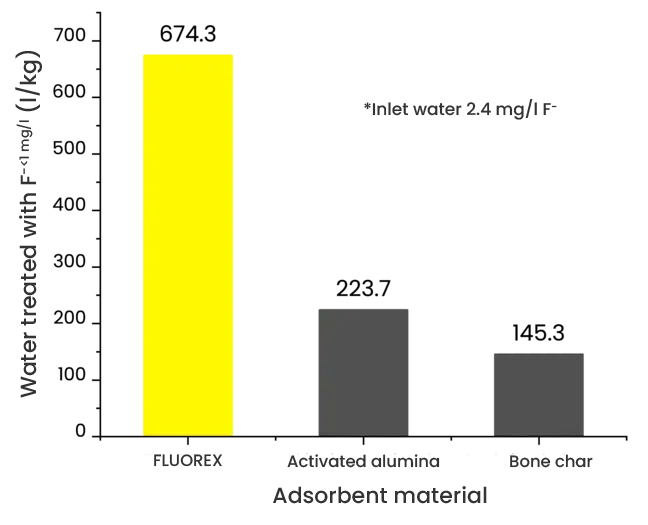
Compared to traditional materials such as bone char, Fluorex offers up to 4.7 times greater treatment capacity, reaching 674.3 liters treated per kilogram before saturation.
In addition, its regeneration is simple and economical: it only requires a 10% solution of sodium hydroxide (NaOH), which can be recovered and reused through a controlled precipitation procedure. Thanks to this closed cycle, up to 99% of the treated water can be reused, decreasing liquid and solid waste to a minimum and operates in a truly sustainable manner.
Fluorex operation is monitored using the rupture curve, which shows fluoride concentrations throughout the operation of the filter. For a typical Mexican water sample with 2.4 ppm fluoride, the quantities remain below the norm in the first volumes, until reaching the design point. This curve allows calculating the volume of water that can be treated and optimizing the design of each particular system.
The shape of the rupture curve and the volume of treatable water depends on factors such as pH, ionic concentration, temperature and the presence of competitive ions. Therefore, customers are asked to complete a form with critical data to simulate Fluorex’s behavior in their specific water and ensure optimal design. This predictive capability and custom design allows us to achieve up to 4.7 times the operating cycle compared to bone char.
Durability and industrial compatibility
The material has intermediate physical resilience, which gives it a useful life of 5 to 8 years with adequate maintenance. Among the main uses and applications of Fluorex are:
- Domestic or rural purification.
- Filtration in the food and pharmaceutical industry.
- Polishing stages in treatment plants.
- Fluoride removal systems in vulnerable communities.
High adsorption capacity, operational versatility, economic regeneration, physical resilience and compatibility are benefits that make Fluorex a viable option for defluorination in all types of populations and scenarios, avoiding the negative impacts that excess fluoride causes on human health, as well as ensuring a fast and sustained elimination process.