
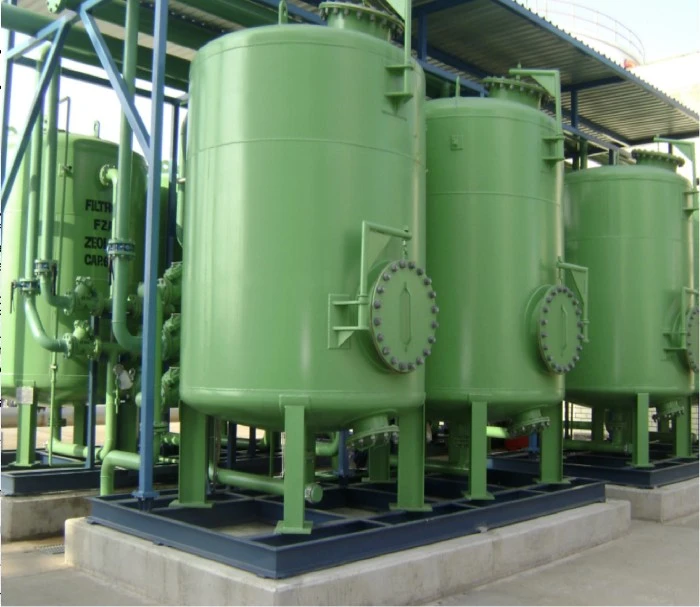
- Zeomedia's first full-scale industrial project.
- 0.7 NTU effluent: the plant eliminated coagulation and flocculation prior to reverse osmosis
- Filtration runs doubled; backwash water consumption reduced by 50%
- OPEX 6.1× lower than silica sand; tanks 29% more compact and without air scouring system
ENG CFE Plutarco Elías Calles
| Parameters | Zeomedia 12 - 20 | Silica sand | Multimedia |
| Tank dimensions | 78” * 48” | 110” * 48” | 90” * 48” |
| Total filter media volume | 400 ft2 | 866 ft2 | 578 ft2 |
| Filtration rate | 8 gpm/ft2 | 4 gpm/ft2 | 6 gpm/ft2 |
| Average operating cycle | 12 hrs. | 4 hrs. | 7 hrs. |
| Outlet NTU | 0.7 - 1.1 | 1.6 - 2.2 | 1.3 - 1.6 |
| Daily water consumption | 288 m3 | 1,944 m3 | 648 m3 |
| CAPEX | 1x | 1.7x | 1.95x |
| OPEX | 1x | 6.1x | 2.1x |
The Plutarco Elías Calles thermoelectric power plant represents our first industrial project. The need for this facility arose between 2008 and 2009 when the ion exchange resin demineralization technology was switched to reverse osmosis trains.
Although the best technical option was chosen, the river water used to feed the reverse osmosis systems contained high levels of microparticles and organic matter.
Because of this, the sand filters installed, both in the old generation units and in the one under construction, failed to reduce turbidity and SDI to the levels required for efficient operation.
This was the reason why the head of the chemical department, Engineer Almanza, began researching other filter media that would allow reverse osmosis to operate properly.
That was why he contacted us to conduct tests with Zeomedia zeolite. First, we supplied filter media for one filter. Seeing the favorable results, he installed our zeolite in an operational treatment train.
Later, he placed a new order for the new generation unit, where zeolite filters were requested right from the start. Therefore, we installed our material’s filters for the new 700-megawatt generation unit.

Outcomes using Zeomedia zeolite.
- Effluent quality. The system consistently reached 0.7 NTU at the outlet. This result allowed CFE to eliminate the coagulation and flocculation stage preceding reverse osmosis. In industrial facilities of this scale, waiving that stage directly reduces coagulant consumption, operating time, and process control points.
- Filtration cycles. Filtration runs doubled compared to the reference system. This reduced water and energy consumption during backwashing by 50%. The table expresses this in absolute terms: 288 m³ daily with Zeomedia compared to 1,944 m³ with silica sand, or 648 m³ with multimedia.
- Cost structure. OPEX with Zeomedia was 6.1× lower than with silica sand and 2.1× lower than with multimedia. CAPEX was 1.7× lower than with sand and 1.95× lower than with the multimedia system. In a continuous generation project, these differentials accumulate across each operating cycle every year.
Technical note: The relative OPEX and CAPEX values in the table correspond to standard design conditions. The actual field differential may vary depending on raw water quality, effective backwash frequency, and specific operating conditions at each facility.