
It is estimated that around 150,000 people in Mexico are exposed to extreme concentrations of between 75 and 350 µg/L, and that there are around 8.8 million people exposed to levels above the WHO safety limit (10 µg/L), which could result in thousands of cancer cases in the northern and central Mexican states.
In fact, a risk of 13,070 new cancer diagnoses is projected in arid areas, as a result of this exposure and the harmful effects of arsenic on health.
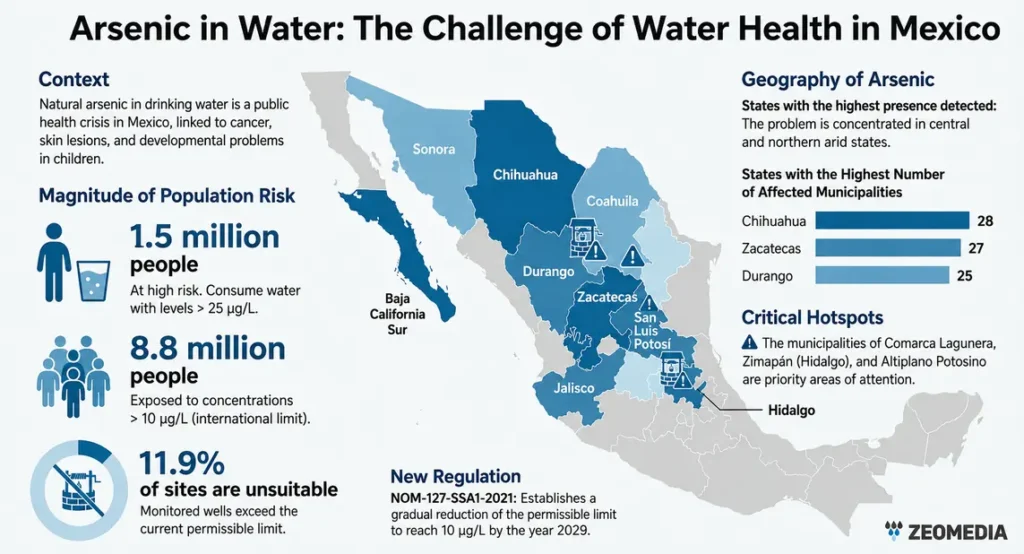
NOM-127-SSA1-2021: The Standard Regulating Arsenic in Water
| Population | Year | Permissible Arsenic Limit | Unit |
| Over 500,000 inhabitants | One year after the entry into force of this standard 0.01 mg/L | 0.01 | mg/L |
| Between 50,000 and 499,999 inhabitants | 3 years after the entry into force of this standard 0.01 mg/L | 0.01 | mg/L |
| Under 50,000 inhabitants | 6 years after the entry into force of this standard 0.01 mg/L | 0.01 | mg/L |
Mexican Regions Most Affected by Arsenic
Contamination is concentrated in arid and semi-arid zones and in mining areas. Problems have been identified in at least 16 states, including Chihuahua, Coahuila, Durango, Sonora, Baja California Sur, Sinaloa, San Luis Potosí, Zacatecas, Aguascalientes, Guanajuato, Jalisco, Morelos, Guerrero, Hidalgo, Michoacán, and Puebla.
| State and region | Situation |
| Hidalgo - Zimapán | It is one of the most studied cases due to its historical mining activity. Deep wells have reported concentrations ranging from 0.058 to more than 1.0 mg/L, massively exceeding the standards. The contamination is mixed, comprising both natural (geological) and industrial (mining and smelting). |
| Coahuila y Durango (Comarca Lagunera) | It is the most studied region since 1960. The overexploitation of the aquifer has caused chronic endemic hydroarsenicism. The most critical areas include San Pedro de las Colonias, Tlahualilo, and Francisco I. Madero. |
| Chihuahua | Jiménez-Camargo: Overexploited aquifer where trace elements such as As, Mo, and V have been detected, following the path of the Conchos River. |
| Valle de Juárez: Child exposure was studied, finding fluoride exposure doses above the tolerable limit. | |
| Aldama y Tabalaopa: A significant coexistence of arsenic and geologically sourced fluoride was identified. Wells like the one at a children's shelter presented 0.035 mg/L of As. | |
| Aguas Termales: Recreational sites such as San Diego de Alcalá, Los Manantiales, and Ojo Caliente present arsenic concentrations above the standard for water bodies (up to 170 µg/L in water and more than 6,000 µg/kg in sediments). | |
| Guanajuato | Celaya (Technological Success Story): In the La Herradura and Santa Rita neighborhoods, concentrations of up to 0.140 mg/L were detected. A water treatment plant using coagulation-microfiltration was successfully implemented, reducing arsenic to 0.01 mg/L, benefiting more than 6,000 inhabitants. |
| Child Exposure: A study in San Agustín (Irapuato) and Cútaro (Acámbaro) found elevated levels of arsenic in the hair of school-age children who consumed well water, compared to control communities in Silao and Tarandacuao. | |
| Durango | Peñón Blanco: Exposure to fluoride and arsenic in urine was quantified. 100% of the tap water samples exceeded the WHO limit for arsenic (average 0.08 mg/L). The exposure was associated with an increased risk of type 2 diabetes mellitus. |
| Valle de Guadiana: A delicate situation, as it is the source of water supply for the city of Durango. | |
| Jalisco y Cuenca de Chapala | Rivera Municipalities: In a study of the municipalities of Tuxcueca, Chapala, Poncitlán, Jamay, Jocotepec, and Ocotlán, it was found that Tuxcueca had average As concentrations of 146 µg/L, which significantly exceeded the standard. An association was identified between exposure and alterations in neuropsychological performance. |
| Colima | Colima y Villa de Álvarez: Cancer risk was evaluated in 36 wells. 80.5% exceeded the WHO recommendation (0.01 mg/L) and 19.4% the previous Mexican standard (0.025 mg/L). A risk was estimated that could cause 446 cancer cases in the exposed population. |
| San Luis Potosí | Studies on neurotoxicity and cognitive deficit in children exposed to arsenic and fluoride carried out by the UASLP are mentioned. |
How to Know if the Water I Drink is Contaminated with Arsenic?
The most certain way to know the composition of the water you drink is to request an analysis to determine the concentration of arsenic or other metals or components.
While this is an unfeasible activity for the general population, public tools offered by public and governmental organizations can be consulted.
To have a visual panorama, you can consult the GapMaps portal, where the INCA (National Water Quality Inventory) provides tracking of wells and potability indicators for each one. Records are available for the years 2017 and 2020.

Sources
- Del Razo, L. M., Ledón, J. M., & Velasco, M. N. (Eds.). (2021). Hacia el cumplimiento del Derecho Humano al Agua. Arsénico y fluoruro en agua: riesgos y perspectivas desde la sociedad civil y la academia en México. Ciudad de México: Universidad Nacional Autónoma de México, Instituto de Geofísica.
- Alarcón Herrera, M. T., Martín Domínguez, A., & Martín Domínguez, I. R. (Coords.). (2013). Flúor y arsénico en agua de consumo humano, retos y perspectivas. Chihuahua, México: Centro de Investigación en Materiales Avanzados (CIMAV) / Red Temática del Agua CONACYT. ISBN: 978-607-8272-11-2.
- Mendoza-Cano, O., Sánchez-Piña, R. A., Barrón-Quintana, J., Cuevas-Arellano, H. B., Escalante-Minakata, P., & Solano-Barajas, R. (2017). Riesgos potenciales de salud por consumo de agua con arsénico en Colima, México. Salud Pública de México, 59(1), 34-40.
- Munguía-Lara, A., Hernández Martínez, J. L., & Martínez Villegas, N. V. (s.f.). Arsénico en el agua potable en México. División de Geociencias Aplicadas, IPICYT.
- Núñez Benítez, J., Ortiz Hernández, L. E., Font Cisteró, X., & Viladevall Sole, M. (2010). Arsénico en aguas de uso potable y control de calidad de las aguas subterráneas en Zimapán, Hidalgo; México. En XV Congreso Peruano de Geología. Resúmenes Extendidos (pp. 96-100). Sociedad Geológica del Perú.
- Escudero Lourdes, C. (s.f.). Arsénico… un asesino lento y silencioso. Ciencia y Desarrollo, CONACYT.
- López Honorato, E., Navarro Tovar, G., Valdés Pech, M., Barroso Flores, J., & Sierra Álvarez, R. (s.f.). ¿Arsénico en agua potable? / Tecnologías para eliminar el arsénico del agua. Ciencia y Desarrollo, CONACYT.
- Fernández-Luqueño, F., Valerio-Rodríguez, M. F., & López-Valdez, F. (s.f.). ¿Es posible limpiar sitios contaminados con arsénico? Ciencia y Desarrollo, CONACYT. (Fuente: CyD 4.pdf)
- Mapa de arsénico en México y notas sobre estados afectados. Ciencia y Desarrollo, CONACYT.
- Oregon Health Authority. (2021). Arsénico. Publicación SP OHA 8329.
- Fertilab. (s.f.). El Arsénico en las Aguas de Riego.lamcorper mattis, pulvinar dapibus leo.