
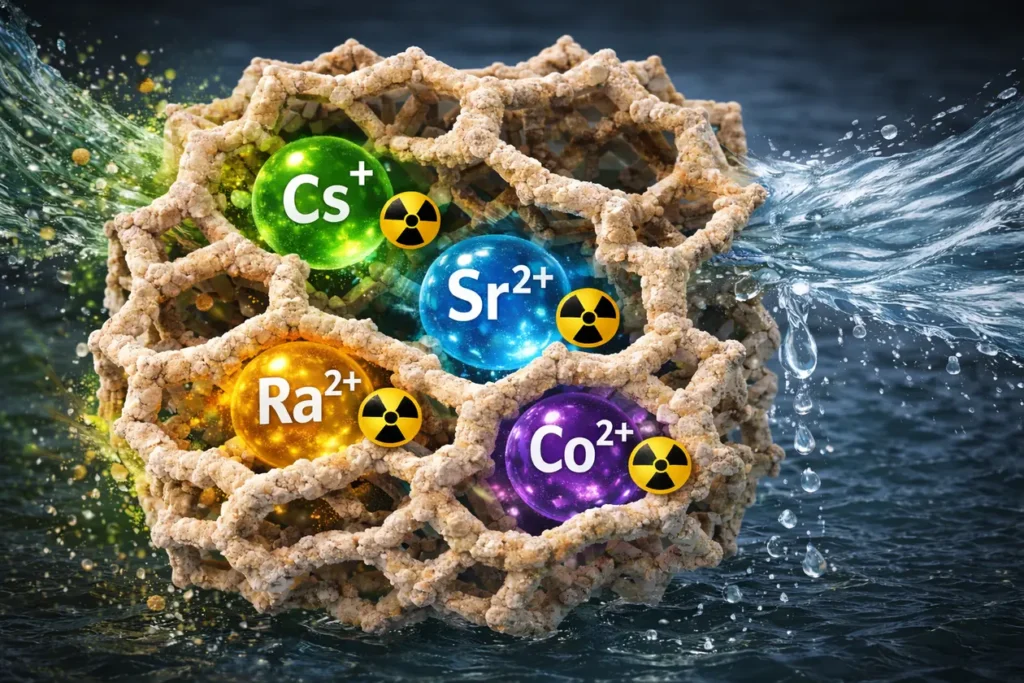
Zeolite for the removal of radioactive contaminants

Zeolita capturando moleculas radiactivas

Natural clinoptilolite zeolite is a highly effective material for the removal of radioactive contaminants from water, such as Cesium (Cs⁺), Strontium (Sr²⁺), Radium (Ra²⁺), and Cobalt (Co²⁺).

Managing radioactive contamination in water sources is one of the most critical environmental challenges facing industries. Radionuclides are of particular concern due to their high solubility in water, their biological behavior, and their relatively long half-lives, which can range from 30 to 1,600 years.


Which radionuclides can zeolite remove?

Clinoptilolite zeolite works as a cation exchanger, capturing positively charged species, but not anions or neutral molecules. The dominant mechanism is ion exchange, with contributions from chemisorption.
 
The applied pseudo-second-order kinetics is consistent with the chemisorption process. Furthermore, the aluminosilicate framework of clinoptilolite is extremely resistant to radiation damage.
 
In fact, an FTIR analysis confirmed the presence of strong coordinated bonds between the radionuclides and the aluminosilicate skeleton.
Radionuclide Ionic form Removable? Efficiency Notes
¹³⁷Cs / ¹³⁴Cs Cs⁺ Yes 95–99.9% Highest selectivity. Primary target in nuclear cleanup.
⁹⁰Sr Sr²⁺ Yes ~80–99% Competes with Ca²⁺. Two-stage recommended in hard water.
²²⁶Ra / ²²⁸Ra Ra²⁺ Yes 45–98.7% Confirmed by ACS, MDPI studies. Commercial Z-88® system in USA. Ba²⁺ is critical competitor.
⁶⁰Co Co²⁺ Yes Moderate Documented in ANPP studies.
¹³¹I I⁻ No N/A Anion. Requires activated carbon or silver-loaded media.
³H (Tritium/Tritio) HTO No N/A Tritiated water. No ion exchange possible.
⁹⁹Tc TcO₄⁻ No N/A Pertechnetate anion.
Zeolite pre-activation with sodium. Pre-activation with NaCl increased Cs adsorption capacity from 67 mg/g to 140 mg/g (+109%), as reported by Prajitno et al. (2020, J. Hazard. Mater.). NaCl brine is preferred for nuclear applications for safety and simplicity. In radioactive applications, regeneration is generally not practiced; the spent zeolite is encapsulated as solid waste.
 
Zeolite pretreatment with ozone. This pretreatment does not present a direct benefit for the removal of Cs⁺, Sr²⁺, or Ra²⁺, as they are in their highest oxidation state. There are no peer-reviewed studies demonstrating direct synergy between ozone and zeolite for radionuclide removal.
 
Possible indirect benefits in waters with high organic load include the degradation of organics that block exchange sites, the prevention of biofouling, and the destruction of organic ligands that complex radionuclides.

Zeolite for Effective Radium-226 Removal

Radium-226 (²²⁶Ra) is a naturally occurring radioactive material found in groundwater worldwide, especially in areas with uranium-bearing geological formations. Radium is also a significant concern in produced water from oil and gas operations, which can contain concentrations much higher than those in groundwater.
 
With a average life of approximately 1,600 years, radium-226 represents a long-term health risk via ingestion. The US EPA has established a maximum contaminant level (MCL) of 5 pCi/L for combined ²²⁶Ra and ²²⁸Ra in drinking water.
 
Multiple peer-reviewed studies confirm that clinoptilolite can effectively capture radium-226 from water:

  • A study published in ACS Industrial & Engineering Chemistry Research tested clinoptilolite for radium removal from simulated produced water with high dissolved solids.
    Natural zeolite showed excellent stability in high-chloride environments, and its capacity and selectivity for radium surpassed those of an ion exchange resin.

  • A study published in MDPI Processes (2020) investigated zeolite, montmorillonite, and biochar for the removal of ²²⁶Ra from aqueous solutions and groundwater. The results showed that the highest removal efficiency values were obtained with clinoptilolite zeolite.
    FTIR analysis confirmed multiple interactions between the zeolite’s functional groups and the adsorbate, thereby contributing to adsorption. A related study using polyacrylonitrile-modified clinoptilolite reported 98.73% removal efficiency for ²²⁶Ra.


How clinoptilolite captures radium
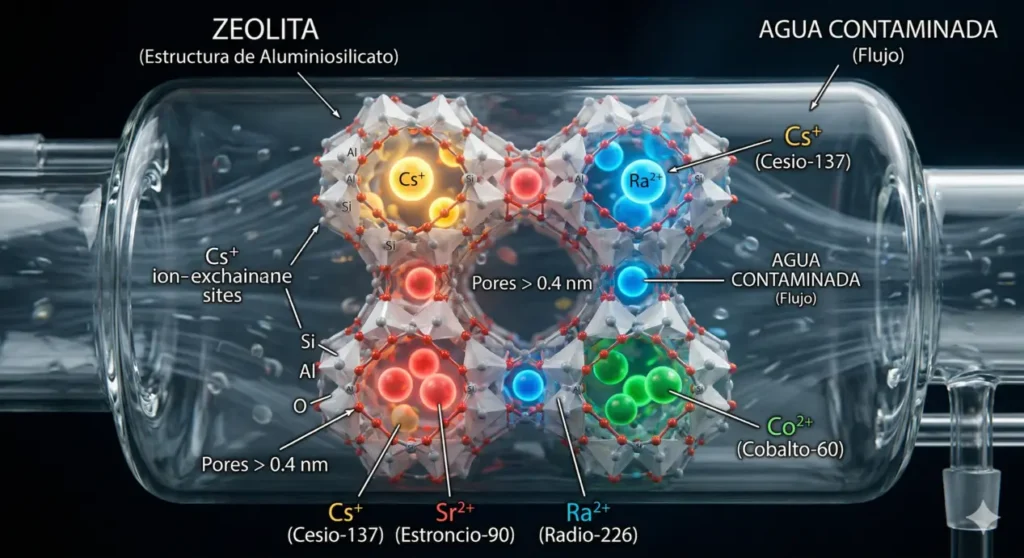
Ra²⁺ is a divalent cation from the alkaline earth metals group, with an ionic radius of 1.48 Å—larger than Ba²⁺ (1.35 Å) and Sr²⁺ (1.18 Å). In Ames’ selectivity sequence, Ba²⁺ ranks above Sr²⁺ and Ca²⁺. Since Ra²⁺ has an even larger ionic radius than Ba²⁺ and belongs to the same chemical group, its affinity for clinoptilolite exchange sites is expected to be comparable to or superior to that of Ba²⁺.
 
The mechanism is primarily ion exchange: Ra²⁺ displaces Na⁺, K⁺, or Ca²⁺ from the zeolite framework.
 
FTIR evidence confirmed changes in Si–O and Al–O bond vibrations after Ra adsorption, suggesting additional surface interactions beyond simple ion exchange.
 
On the other hand, a key limitation to radium removal occurs when the water contains barium (radium-barium water type): treatment efficiency is only 45% for the first liter and drops to 0% after the fourth liter. This decrease results from competitive adsorption by barium ions, which have ionic radii and chemistry very similar to those of Ra²⁺.
 
Barium directly competes for the same exchange sites, quickly saturating the zeolite. Therefore, for water sources with elevated barium concentrations, pretreatment to remove barium or alternative technologies (e.g., co-precipitation with BaSO₄) may be necessary before ion exchange with zeolite.
 
The most notable commercial application of zeolite for radium removal is WRT’s Z-88 Radium Removal Solution, developed by Water Remediation Technology (WRT).
 
The system uses a series of upward-flow fluidized beds of zeolite media. Pilot studies are conducted for 100-115 days to demonstrate compliance with EPA requirements. This approach has been successfully deployed in US communities to bring drinking water into compliance with the Safe Drinking Water Act.
Zeolita seleccionando elementos radiactivos

Competitive Ions: Identification, Selectivity, and Kinetics

Ames’ (1960) cationic selectivity sequence: Cs⁺ > Rb⁺ > K⁺ > NH₄⁺ > Ba²⁺ > Sr²⁺ > Na⁺ ≈ Ca²⁺ > Fe³⁺ > Al³⁺ > Mg²⁺. Ra²⁺ is expected to rank near Ba²⁺ based on its similar alkaline earth metal chemistry and larger ionic radius.

  • K⁺ – MOST PROBLEMATIC for Cs: 3rd rank, similar ionic radius. Most effective competitor according to SIXEP studies (Dyer et al., 2018).
  • Ca²⁺ – MOST PROBLEMATIC for Sr and Ra: almost identical chemistry. In hard water (>100 mg/L Ca), Sr removal can drop below 50%. For Ra, Ca also competes strongly.
  • Ba²⁺ – CRITICAL for Ra: Ba²⁺ is the most aggressive competitor for Ra²⁺ due to its nearly identical ionic radius (Ba: 1.35 Å, Ra: 1.48 Å). Samolej et al. (2021) showed that Ra removal dropped to 0% after 4 liters in Ba-rich water.

Clinoptilolite is much more selective for Cs⁺ than for Ca²⁺ or Mg²⁺. Even in very hard water, Cesium is preferentially captured. For strontium and radium, high Ca/Ba concentrations are problematic. Two-stage filtration is recommended when Sr/Ra removal is >90%, and hardness is >200 mg/L CaCO₃.


Alternative Technologies for Radioactive Water Treatment

  • Natural clinoptilolite zeolite remains the most cost-effective option (at ~$0.10 to $0.50 per kg, compared to $50 to $100+ per kg for synthetics).
    For Ra specifically, the synthetic NaP1 zeolite is more efficient than clinoptilolite, but the natural option is commercially proven for Ra compliance in drinking water (WRT’s Z-88 System).
  • Hexacyanoferrates offer exceptional selectivity for Cs in seawater (82–454 mg/g Cs) but at a very high cost.
  • Sodium titanate stands out for Sr²⁺.
  • Organic resins are not recommended due to their poor radiation stability.
  • CST (Sandia/UOP) is highly selective but is expensive.


Regeneration or Replacement?

The standard approach is to replace and immobilize the material, as regeneration is not recommended.
 
Regeneration with brine generates concentrated radioactive liquid waste, which is more difficult to manage; it achieves only partial desorption (Cs recovery of approximately 23%), increases worker radiation exposure, and violates regulatory preferences.
 
Zeomedia, manufactured by Zeomex, contains 80–85% clinoptilolite and <3% clay, certified to NSF/ANSI 61. High purity increases Cs adsorption and radionuclide capture capacity (Prajitno et al., 2020).
Higher purity = more active exchange sites = better potential for radionuclide capture per unit volume.
 
Note: Zeomedia is not currently marketed or certified for radioactive water treatment applications. Any nuclear application would require independent testing, pilot validation, and regulatory approval.
 
Disclaimer: This article is for educational purposes. All data is from published, peer-reviewed sources or case studies. Zeomedia is certified for water filtration but not for radioactive decontamination. Nuclear applications require independent testing and regulatory approval.
 

Sources

Ames, L.L. (1960). The cation sieve properties of clinoptilolite. American Mineralogist, 45(5–6), 689–700.

Ames, L.L. (1962). Effect of base cation on the cesium kinetics of clinoptilolite. American Mineralogist, 47, 1317–1326.

Campbell, L.S. & Davies, B.E. (1997). Plant and Soil, 189(1), 65–74.

Cortés-Martínez, R. et al. (2010). Desalination, 258, 164–170.

Dyer, A. et al. (2018). J. Radioanal. Nucl. Chem., 318(3), 2473–2491.

Erenturk, S. & Kaygun, A.K. Clinoptilolite-PAN composite: 98.73% ²²⁶Ra removal.

Faghihian, H. et al. (1999). Applied Radiation and Isotopes, 50, 655–660.

Gevorkyan, R.G. et al. (2013). Scientific Reports, 3, 2900.

GOV.UK (2024). Sellafield SIXEP Case Study.

Kanchanawanichkun, P. et al. (2023). Sep. Purif. Technol., 312, 123321.

Komarneni, S. & Roy, R. (2014). Scientific Reports, 4, 4195. [Pollucite synthesis]

Li, L. & Wang, J. (2005). Zeolite in cement reduces radionuclide leaching.

Nakamoto, K. et al. (2016). Ind. Eng. Chem. Res., 55(25), 6996–7002.

Prajitno, M.Y. et al. (2020). J. Environ. Chem. Eng., 7(4), 103227.

Samolej, K. & Chalupnik, S. (2021). J. Environ. Radioactivity, 229–230, 106529.

Senila, M. et al. (2023). Materials, 16(8), 3218.

WaterWorld (2007). Zeolite-Based System Safely Removes Radium From Drinking Water.

Yusuf, M. & Wisnubroto, D.S. (2024). AIP Conf. Proc., 2967(1), 170007.

ACS Ind. Eng. Chem. Res. Clinoptilolite for Ra removal from produced water.ACS Ind. Eng. Chem. Res. Clinoptilolite for Ra removal from produced water. DOI: 10.1021/acs.iecr.6b03230.

MDPI Processes (2020). Zeolite, montmorillonite, biochar for ²²⁶Ra removal. 8(12), 1537.